
Study of some processing changes in proteins
Protein solubility is an important functional property in food systems, influencing texture, stability, emulsification, and foaming behavior. It is affected by several factors such as pH, temperature, ionic strength, and the intrinsic structure of the protein. Among these, pH plays a dominant role in determining protein solubility.
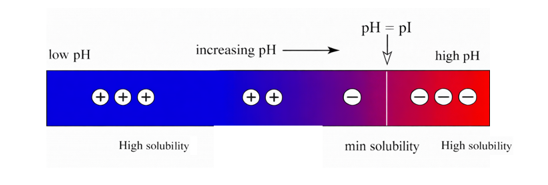
Proteins are amphoteric molecules containing both acidic (–COOH) and basic (–NH₂) groups. Depending on the pH of the surrounding medium, proteins can carry a positive charge, negative charge, or no net charge.
At a specific pH known as the isoelectric point (pI):
• The number of positive and negative charges on the protein are equal.
• Net charge becomes zero.
• Electrostatic repulsion between molecules is minimized.
• Protein molecules aggregate and precipitate.
• Solubility is at its minimum.
At pH values below or above the pI, proteins carry a net charge (positive or negative), leading to electrostatic repulsion between molecules. This prevents aggregation and increases solubility.
Protein solubility is determined by measuring the amount of protein remaining in the supernatant after removal of the precipitated fraction. Comparing this value with the total protein initially added allows calculation of percentage solubility.
This experiment demonstrates the relationship between pH and protein solubility, highlighting the concept of the isoelectric point and its practical significance in food formulation and processing.