
Detection and estimation of oxidative rancidity in fats/oils
Oxidative rancidity is one of the most common causes of quality deterioration in edible oils and fats. It primarily involves the reaction of atmospheric oxygen with unsaturated fatty acids present in lipids. This reaction proceeds through a free radical chain mechanism consisting of initiation, propagation, and termination steps.
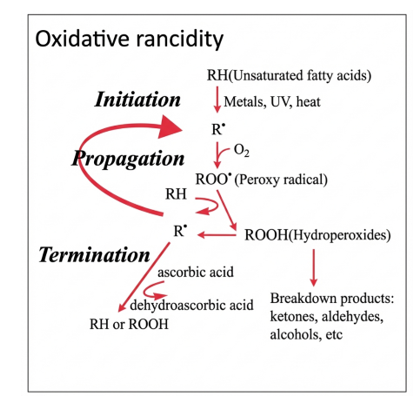
Although hydroperoxides themselves are relatively odorless, they are unstable and decompose into secondary oxidation products such as aldehydes, ketones, and acids, which are responsible for rancid odor and flavor.
Factors Affecting Oxidative Rancidity
The extent of oxidation depends on:
• Degree of unsaturation of fatty acids
• Temperature (higher temperature accelerates oxidation)
• Exposure to light (photo-oxidation)
• Oxygen availability
• Moisture content
• Presence of pro-oxidant metals
• Storage duration
Polyunsaturated oils oxidize more rapidly than saturated fats.
Principle of Peroxide Value Determination
Peroxide value (PV) measures the amount of hydroperoxides formed during lipid oxidation and is expressed as:
Milliequivalents of active oxygen per kilogram of fat (mEq/kg).
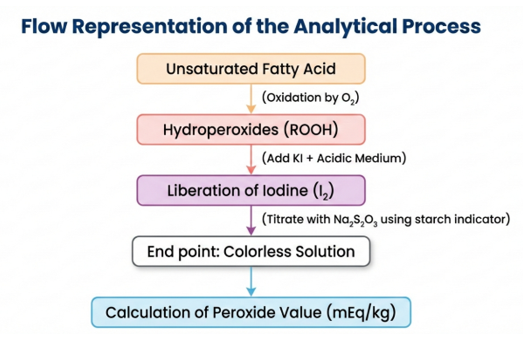
The method is based on iodometric titration, where hydroperoxides oxidize iodide ions to iodine in acidic medium.
Step 1: Liberation of Iodine
ROOH + 2I⁻ + 2H⁺ → ROH + H₂O + I₂
The liberated iodine imparts a brown color to the solution.
Step 2: Titration with Sodium Thiosulphate
I₂ + 2S₂O₃²⁻ → S₄O₆²⁻ + 2I⁻
As sodium thiosulphate is added, the brown color fades. Near the endpoint, starch indicator is added, producing a blue complex with iodine. The disappearance of the blue color indicates the endpoint. Given below is a simplified flow representation of the analytical process.
Interpretation of Peroxide Value
• Fresh oils: typically < 10 mEq/kg
• Moderate oxidation: 10–30 mEq/kg
• Rancid oils: 30–40 mEq/kg or higher
However, very high peroxide values may sometimes decrease if hydroperoxides decompose into secondary oxidation products; therefore, peroxide value mainly indicates the early stages of oxidation.
Thus, peroxide value determination provides a quantitative measure of primary lipid oxidation and serves as an essential quality control parameter in edible oil processing, storage, and safety evaluation.