
Determination of functional property (Foaming property) of protein
Foaming properties of proteins are important functional characteristics in many food products such as whipped creams, mousses, cakes, and aerated beverages. Foam is a colloidal system in which gas (air) is dispersed in a liquid phase and stabilized by surface-active agents like proteins. The ability of proteins to form and stabilize foams affects texture, volume, and sensory quality.
When a protein solution is subjected to whipping or agitation, air is incorporated into the liquid. Proteins migrate to the newly created air–liquid interface, where they partially unfold. Their hydrophobic groups orient toward the air phase while hydrophilic groups remain in the aqueous phase, forming a viscoelastic interfacial film that stabilizes air bubbles and prevents coalescence.
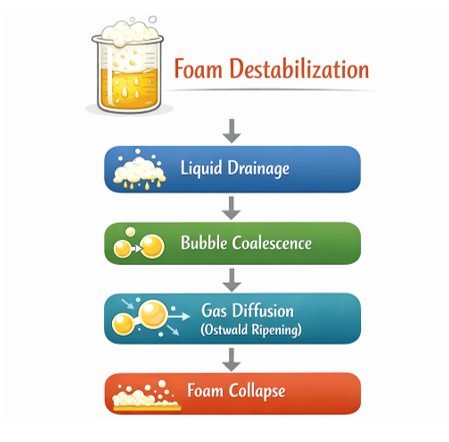
Foam stability refers to the ability of the foam to resist collapse over time. Destabilization occurs due to liquid drainage, bubble coalescence, and gas diffusion (Ostwald ripening). The strength, elasticity, and thickness of the protein film largely determine stability. The foam destabilization phenomena is depicted in the figure alongside.
Measurement of Foaming Properties
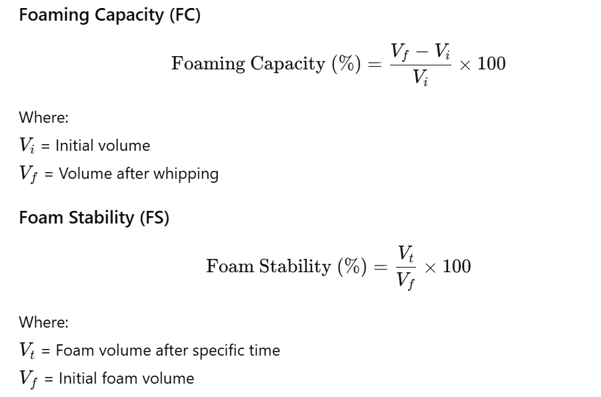
Foaming Capacity (FC)
Higher protein concentration generally improves foam formation and stability due to greater interfacial coverage. However, excessively high concentrations may increase viscosity and hinder air incorporation.